
I’m not ready yet.
I need more insight.
I can’t…
I’m not…
I haven’t…
What if you’re more ready than you think, and less willing than you’ll admit?
I know—sometimes postponing feels like the responsible choice.
It looks measured. Thoughtful. Wise. We might tell ourselves we’re waiting on clarity, waiting on peace, waiting on God. We say we just need more time. More confirmation. One more sign. A little more something.
And on the surface, that’s right.
There are seasons where waiting is the only faithful option. There are things entirely outside our control; things only God can do—things that require endurance and not necessarily action. There are moments where stillness and patience are the only answers.
But can you also agree that there are moments when our delay has less to do with waiting on God or waiting for a particular feeling and more to do with avoiding what we think movement will cost?

Before going further, let me be clear about what I’m talking about.
This isn’t about procrastination, where we put off what we clearly know we should do—and it’s not about delaying repentance, skirting boundaries, or refusing to walk away from what we already know isn’t good.
It’s also not intentional delay, where we’ve already chosen a course of action and are simply waiting for a set time to carry it out. That’s restraint, and typically, is a good thing.
I’m talking about a more subtle kind of tension.
The desire to live a life actively stewarding of our time, talent, and treasure—with the purpose of bringing further honor and glory to God—is a beautiful thing. And with it comes a specific flavor of tension when the options in front of you aren’t obviously wrong, but they aren’t automatically right either.
Allow me to get granular: I’m talking about that specific tension of being torn between what feels practical, safe, and controllable versus what requires us to spend more time kneeling in dependence at His throne.
If any of this is hitting close to home, let me get even more specific:
Where does this tension show up for you?
What’s the thing that feels important but unresolved.
The thing you feel drawn toward, but you’re afraid of the cost.
I’ll share my most recent experience with this.
For a season I put this blog down because I was afraid of what it might cost me. Time. Direction. Exposure. But there was no question that I felt drawn to writing, documenting and expressing in the way I do here at Faith on the Page.
At the same time, I questioned everything. Was this ego? Was I just wanting to be seen? Is this something I should be doing with my time? Is God even in this? Confusion crept in, and I told myself I was being wise by pausing and waiting for clarity. But if I’m being honest, part of me was hiding.
Underneath the hesitation was a belief I didn’t want to name.
What if I’m going in the wrong direction?
What if this is just a selfish ambition?
What if God has something entirely different for me and I’m forcing my own plans?
I told myself I was being cautious. Responsible. Discerning.
But really, this was fear.
Fear that my motives were off and that my heart wasn’t as pure as I hoped.
Fear that I might invest time and energy into something that wasn’t for me.
And here’s the thing: these weren’t irrational thoughts. It is possible to misstep, and it is possible to be off by a few degrees.
But I wasn’t accounting for the fact that God already knows the good, bad, and the ugly within our hearts. Our limitations, our leanings and tendencies are not a surprise to Him and He’s very aware of the areas that are still being shaped.
He’s not wringing His hands while we try to decipher His will!
Sometimes delay is less about the decision and more about what it threatens to reveal. It’s about what it will require and what it will expose in us.
Speaking as an imperfect human to another imperfect human (you, dear reader), it can be a daunting task to look our beliefs and shortcomings in the face. I mean, our brains will do almost anything to protect us from pain and difficultly. Should we be surprised that our fear and the lag that stems from it would disguise itself as wisdom and prudence? No.
Anyone seriously wrestling with this kind of tension likely has a deep desire to steward well what God has given them. Otherwise, we’d chase every promising idea or dismiss anything unfamiliar without taking time to discern whether or not we should pursue.
I’m trusting that you already know that slowing down to seek wisdom and wise counsel matters. I trust that you know that fine tuning our discernment takes time and experience. And if you didn’t know that—I trust that you’ll take those truths with you after reading this. But, the question I have is:
Can we/do we notice the difference when faithful listening shifts to stagnation or avoidance?
The lines between avoidance, stewardship and perfectionism can become blurry if we’re not paying attention.
Healthy stewardship leads to inspired action — or a clear, unregretted no.
Perfectionism leads to fear and avoidance.
Avoidance leads to regret and resentment.
If you’re picking up what I’m putting down and you can name where this tension shows up for you, I’m going to guess that you feel drawn in a particular direction. I’m simultaneously guessing you hold a belief that directly counters that. Otherwise, you would already be in motion, or have already let it go entirely. It can look like feeling drawn, curious, impassioned, even confident—while also believing that something about it, or the process of it, is unsafe, irresponsible, or unreachable.
My friend, I want to affirm you here; whatever you’ve decided to stall does not mean you don’t care and it doesn’t mean you’re lazy, unmotivated, or irresponsible.
It means you are divided.
Subconsciously, there’s a whole cowboy standoff happening.
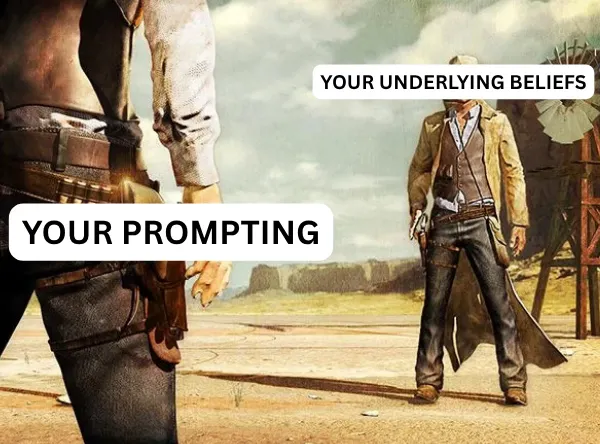
You’re not confused, you’re caught between a clear prompting and a set of beliefs that make yielding to it feel risky, premature, or unwise. And when those two don’t agree, delay feels like the safest place to live. It might not be right, but it’s not wrong, is the idea.
Here’s what’s scary about this reality: when we live divided long enough, we get used to the in-between. We get comfortable in hesitation and indecision. And over time, it reshapes how we move through life. We become more guarded, less decisive, and less willing to trust what God is doing within us.
Long-term delay protects the conflict.
And protected conflict never produces maturity.
When we act, we choose which belief*s* get to lead. Our practices become our posture; and we can subtly accept division as normal in a multitude of areas, and we shrink ourselves because of it. Until our divided beliefs are held under a microscope, they will continue to drive our action or non-action.
We can pray about the thing without partnering with God through movement.
We can talk about what we plan to do without taking steps toward it.
We can say we trust God while still gripping control and protecting fear.
And what actually grows?
Certainly not faith.
If division is what keeps us stuck, then the real questions become:
What do I believe about myself?
What do I believe about the promises of God and how they apply to me here?
What do I believe will happen if I move?
This reminds of James 1:8, where he speaks of the double-minded person being unstable in all their ways. For context, he was speaking about faith in the Lord, but do you see the parallel? When we hold opposing beliefs at the same time—whether we recognize it or not—and refuse to really examine either one, what else could we be, but unable to move forward?
Hear me out, I’m not saying pick a belief and run with it. I’m not saying take immediate action, and I’m not encouraging you to ask God to just endorse one belief and erase the other. At least not yet.
I am saying that clarity is born from participation, not passivity.
Because God is not waiting for you to make a perfect move before He begins guiding you. He is already guiding you.
He is not threatened by your humanity. If you step a few degrees off, He is faithful to redirect. If your motives need refining, He will refine them. If your understanding is incomplete, He will grow it.
We aren’t navigating alone, and we’re not one wrong step away from ruin.
Trusting Him does not mean moving recklessly. It means moving honestly, knowing He is steady enough to correct your course.
Take the beliefs you’re holding and lay them against Scripture. Some of them will stand. Some of them will not. Nowww I’m encouraging you to ask God to endorse one belief (the truth) and remove the other (the lie).
We can take these specific beliefs into prayer and ask God to refine what’s distorted. We can ask Him to strengthen what aligns with Him and His plans. We can ask Him to highlight and remove what is rooted in fear rather than trust.
There’s no formula, and we can’t predict outcomes but examining and surrendering what we’ve been believing is a faithful beginning to whatever step God may lead us into next.
So be brave enough to be honest, my friend.
Not so you can rush forward. But so that you no longer remain divided and motionless. So you can be whole in thought and action, and move toward the plans and purposes God has for you.
I don’t know what you’re delaying. But if you’ve read this far, you probably felt it surface.
Sit with what you believe.
Let truth clarify it.
And when you are no longer protecting the conflict, respond from wholeness.
May you have the courage to examine the beliefs that keep you divided. May you bring them to the light of God’s truth, so that wholeness and clarity can emerge. Your steps may not be perfect, but you are covered by the One who is. So walk boldly, friend, into the plans and purposes He has for you.
Blessings,
Diamond